Why brand matters for AI Visibility
The Verge’s Nilay Patel predicted “Google Zero” as the moment when search traffic to websites slows to a crawl because the search engine has evolved into the answer engine. No further clicks required. This moment came to pass in May 2026, when Google released its redesigned search box with prominent AI summaries.
The evidence of this collapse is hard to ignore. A Pew Research analysis of over 68,000 searches reveals that click-through rates have dropped from 15% to just 8% when AI summaries are present. Cloudflare data confirms that over 50% of web traffic is now non-human.
AEO: Branding for the Machines
AI models do not see your brand as a logo. They see it as an entity derived from connected data points scattered across the internet. If your brand identity and messaging is inconsistent, AI registers these instances as disparate entities instead of connecting them to your brand presence.
The good news is that AI does not default to the biggest brand. It defaults to the most clear and visible one. This allows smaller and niche brands an opportunity to become authorities in their category. This means being cited by AI when it matters most: when the consumer is asking a specific question to solve a specific need. Well-structured content from a niche authority will carry more weight than broad messaging from a larger brand.
This brings us to Answer Engine Optimization, or AEO (or GEO, if you prefer: “Generative Engine Optimization). Marketers must define their brands as a verifiably unique entity. This requires moving beyond keywords to content clarity. If your brand name, address, category, services, and benefits vary across Google entries, social media, and your website, the AI views you as an unreliable source. If your content is overly broad, it can fall into the “interchangeability trap” where AI treats your brand as generic rather than a unique solution.
The source of this content, or the people that provide the content of the brand, needs to be verifiably sourced as humans connected to the larger brand. Bylines and links to social media don’t just acknowledge the author or creator, they acknowledge humanity.
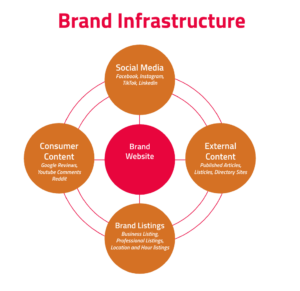
Tell your story to a human, structure your story for a machine.
While AEO manages the machine, your brand must ultimately resonate with humans. In the AI era, brand clarity is your greatest defense against becoming an invisible commodity to both AI agents and human customers. Any changes to content that you make to better serve AEO should be balanced to make sure that humans still receive the brand messaging that you intend. There are no shortcuts. Quality content accumulated over time is the best solution for both humans and AEO.
Brand Clarity Pillars:
- Voice & Tone: This is more than just a style preference. It becomes a distinct identity marker that must remain constant across all communications.
- Messaging Pillars: These are the key themes that define your value. Consistent reinforcement trains the algorithms on your expertise while building credibility with humans.
This brand clarity should carry over into structured data that will be easily found and interpreted by AI agents.
Technical Checklist:
- EEAT Signals: Where appropriate, make sure that your authors and creators are credited as verifiable humans that can be connected to your brand and defined by their own online presence. This boosts Google’s EEAT signals (Experience, Expertise, Authorativeness and Trustworthiness)
- Answer-First Copy: Lead every section of your brand website with an easily extractable summary. Adjectives and adverbs weaken extractability. Named facts and specific numbers strengthen it.
- Self-Contained FAQ Structures: Use the H2 “Frequently Asked Questions” heading, phrased exactly as users ask them. H3 questions must be followed by 2–5 sentence answers that make sense in total isolation. Shoutout to my fellow human nerds that understand that tech talk.
- Earned Media as Validation: 82% of AI-cited links come from earned media. Press release citations have increased fivefold in the last six months alone.
- Off-Site Authority: Social content generates 2.5x more AI citations than owned brand pages. Engagement on Reddit, social media, and industry directories is no longer optional.
How long do you need to give the bots?
- Internal Coverage: Expect a lift in AEO coverage from structured data changes on your branded site within 14-21 days. These can include updated Schema and adding an llm.txt file.
- External Validation: Third-party reviews and reputation signals typically take 60–90 days to influence the model’s recommendation engine.
Winning Hearts and Algorithms
While AI-driven search will likely reduce traffic to your site, it also provides an opportunity to stand out with your brand’s expertise. Your brand, structured for both humans and machines, creates this uniqueness. By being recognizable to people through storytelling and architecturally clear to machines through AEO, you transform the disruption of AI into greater brand visibility in an increasingly noisy world.