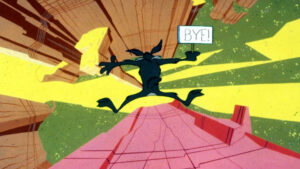
Does your brand beep?
Lessons from the Road Runner.
Brand building is world building. Or at least it should be. Every graphic, message, touch point, and experience becomes a detail of your brand story. That consistency creates stickiness and builds a stronger connection with your audience. Over time, this long game creates a shared shorthand. Your point becomes sharper and you get there faster. Stories feel deeper when read from a common point of view. The joke is funnier when everyone’s in on it.
The first step to building a world is establishing boundaries. Otherwise, you’ll just find yourself floating aimlessly in deep space. Similarly, brands need rules. Even if your brand is set on breaking the rules, it needs its own standards of irreverence and antagonism.
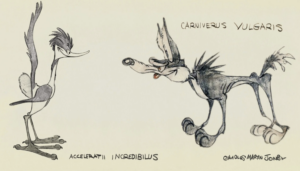
When Chuck Jones created the Road Runner and Wile E. Coyote in 1949, he established a clear and charming set of rules.
- The Road-Runner cannot harm the Coyote except by going “beep-beep!”
- No outside force can harm the Coyote—only his own ineptitude or the failure of Acme products.
- The Coyote could stop anytime—if he were not a fanatic.
(Repeat: “A fanatic is one who redoubles his effort when he has forgotten his aim.” –George Santayana) - No dialogue ever, except “beep-beep!”
- The Road-Runner must stay on the road—otherwise, logically, he would not be called Road-Runner.
- All action must be confined to the natural environment of the two characters—the southwest American desert.
- All materials, tools, weapons, or mechanical conveniences must be obtained from the Acme Corporation.
- Whenever possible, make gravity the Coyote’s greatest enemy.
- The Coyote is always more humiliated than harmed by his failures.
These guidelines established the Road Runner’s world and, more importantly, built a playground for ideas. It’s a formula. But it’s potent when you stick to it.
As Chuck himself noted:
Many people do not know there is such a creature as a roadrunner outside Warner Bros. cartoons. An ornithologist at the University of Iowa, who is a roadrunner expert, told me that the first question asked by her students every year is, “Does the true roadrunner really go ‘beep-beep’?” and they do not believe her when she tells them that it doesn’t.
https://chuckjones.com/characters/road-runner/
Tone of voice. Key language. Colors. Typography. Photography. Relentless consistency with all these facets help build a sticky brand. But most importantly, you need to establish a point of view.
Where are you coming from? Where are you going? And why should anyone join you? That’s your brand essence. In today’s world of a million screaming screens, it offers a bridge above the noise and clutter. Being seen doesn’t really mean much if your brand doesn’t mean anything to the viewer.
Brand is the foundation on which performance success is built: the stronger the brand, the stronger the foundation. But “brand” need not be the grand campaign of old, it is built consumer by consumer, exposure by exposure, no matter how small. So identify what you want your brand to be known for, and start communicating it now, as it can build better outcomes for your performance business over the long term. – Rory Dolan, Head of Marketing Science at TikTok


Brand standards are the source of brand power. Case in point, this recent work for McDonald’s New Zealand. No photos. No arches. No URL. You get it. Beep-beep!